

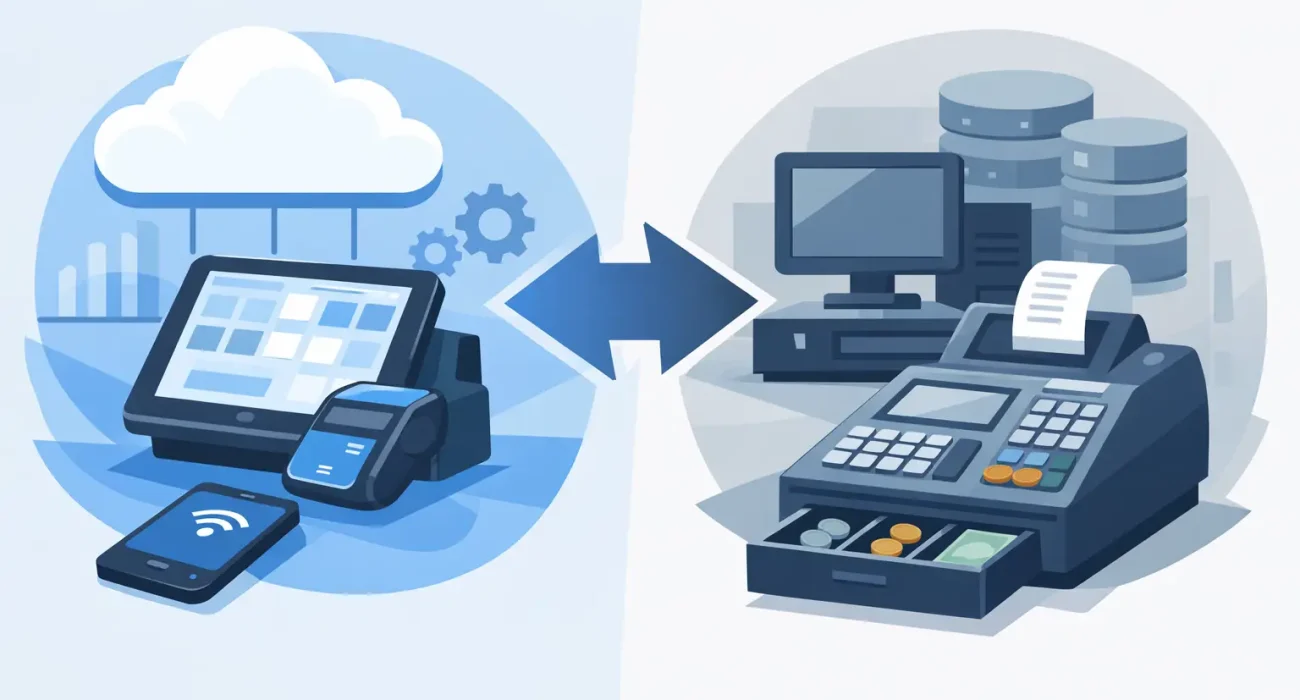
A busy lunch rush is the worst time to discover your POS depends on one aging back-office machine. Orders back up, staff start improvising, and management is left asking the same question many growing businesses face: cloud pos vs legacy systems – which one actually supports day-to-day operations without creating new risks?
For restaurants, retailers, and other service businesses, that choice affects far more than checkout speed. It shapes reporting accuracy, staff mobility, system maintenance, customer experience, and how easily the business can grow. The right answer is not always the newest option by default, but for many operators, the gap between modern cloud tools and older on-premise setups is becoming harder to ignore.
Cloud POS vs Legacy Systems: The Core Difference
At the simplest level, a cloud POS stores and syncs data through internet-connected infrastructure, while a legacy system usually runs from local servers or individual terminals on-site. That difference changes how software is updated, how reports are accessed, and how easily owners can manage multiple locations.
A legacy POS often feels familiar because it has been in place for years. Staff know the screens, managers know the workarounds, and the business has built routines around its limits. But familiarity is not the same as efficiency. Many older systems were designed for a more isolated operating model, where the cash register was mainly a transaction tool rather than part of a broader business platform.
Cloud POS platforms are built with a different expectation. They are meant to connect sales, inventory, customer data, and reporting in real time. For an owner who wants to check performance from outside the store, compare branch activity, or update menus without waiting for a technician, that matters immediately.
Why Businesses Are Reconsidering Legacy POS
The pressure usually starts with a practical problem, not a technology trend. A retailer may struggle with stock mismatches between branches. A restaurant may want delivery, QR ordering, or faster menu changes. A manager may simply need live reporting instead of waiting until the end of the day.
Legacy systems can still process sales, but they often become expensive in the areas that matter most over time. Hardware ages. Updates are limited or no longer supported. Integrations with newer tools become difficult. Small issues that were once manageable start slowing down staff and creating blind spots in decision-making.
This is especially relevant for businesses that want tighter control across operations and marketing. If your POS data sits in one place and your customer-facing systems sit somewhere else, growth becomes harder to manage. You spend more time patching gaps between tools and less time acting on reliable information.
Cost Is Not as Simple as Upfront vs Monthly
Many decision-makers compare cloud pos vs legacy systems by looking at payment structure alone. Legacy systems often appear cheaper after the initial purchase because there may be no obvious monthly software fee. Cloud systems usually involve subscriptions, which can look like a higher ongoing cost.
That comparison is incomplete.
A legacy setup often carries hidden costs in maintenance, on-site troubleshooting, server replacement, manual backups, and specialized support. If a system goes down and only one person knows how to fix it, the real cost is operational disruption. If reporting requires staff time every day, that labor cost adds up too.
Cloud POS usually shifts spending into a more predictable service model. You pay regularly, but updates, access improvements, and support structures are often included. For businesses that value stability and visibility in budgeting, that can be an advantage rather than a drawback.
Still, the answer depends on business type. A single-location shop with very simple needs may tolerate a legacy setup longer than a multi-branch restaurant group that needs centralized reporting and flexible menu management. The more moving parts your business has, the more expensive old limitations become.
Reliability, Internet Dependence, and Real-World Risk
One of the most common objections to cloud POS is internet dependence. It is a fair concern. If your connection drops, you need confidence that the system can continue taking orders or processing transactions in an offline mode until service is restored.
That is why the quality of the platform matters more than the label. A well-implemented cloud POS should account for temporary connectivity issues and provide continuity for core operations. A poorly chosen cloud platform can create frustration just as easily as an outdated legacy system.
On the other hand, legacy systems are not risk-free simply because they are local. If a local server fails, data becomes corrupted, or aging hardware breaks during peak hours, recovery may be slow and costly. Older systems also depend heavily on disciplined manual processes for backup and maintenance. In real business conditions, those processes are not always followed consistently.
Reliability is less about whether the system is cloud-based or on-premise and more about how well it is deployed, supported, and maintained. That is where working with a responsive implementation partner becomes important, especially for businesses that cannot afford long downtime.
Reporting and Visibility Change the Quality of Decisions
A POS should do more than record transactions. It should help owners and managers make faster, better decisions.
This is one of the clearest advantages in the cloud pos vs legacy systems discussion. Cloud platforms tend to give decision-makers immediate access to sales trends, product performance, staff activity, and location-level insights. That visibility supports practical decisions such as adjusting staffing, identifying slow-moving inventory, changing promotions, or spotting unusual patterns before they become costly.
With many legacy systems, reporting is slower, more manual, or limited to the terminal where the data is stored. Information may still be available, but not in a way that supports timely action. For an owner managing multiple responsibilities, delayed data often means delayed decisions.
In sectors like restaurants and retail, speed matters. If one menu item is underperforming, one branch is overselling stock, or one promotion is driving better results than expected, you want to know early. Better visibility does not just improve reporting. It improves control.
Growth and Integration Matter More Than Ever
Businesses rarely stay static. A startup adds a second location. A retailer expands into e-commerce. A restaurant introduces delivery channels, loyalty tools, or digital menus. When that happens, the limitations of older systems become much more visible.
Legacy POS platforms often struggle when businesses ask them to do more than they were originally designed for. Integration can require custom work, third-party patches, or manual reconciliation between systems. That slows growth and increases the chance of errors.
Cloud POS is generally better positioned for connected operations. It can support centralized management, faster rollouts, and cleaner integration with other business software. For companies that want their technology stack to support expansion instead of resisting it, that flexibility is a major advantage.
This is particularly relevant in markets where customer expectations are rising. Faster service, better payment options, cleaner reporting, and stronger digital coordination are no longer extras. They increasingly shape how a business competes.
When Legacy Still Makes Sense
There are cases where replacing a legacy system is not the immediate priority. If the operation is very small, the workflow is stable, and the current setup is reliable, a full migration may not produce enough short-term value to justify the disruption. Some businesses also operate in environments where change management is a bigger challenge than technology itself.
But even then, it is worth asking a harder question: is the system still supporting the business, or is the business quietly adapting around the system?
That distinction matters. If staff are using side spreadsheets, calling managers for manual overrides, or delaying updates because the POS cannot keep up, the system is already costing more than it appears.
Choosing the Right Direction
The best decision starts with operations, not software features. Look at how your team works during peak hours, how management reviews performance, how often pricing or menus change, and whether your current setup supports expansion. Then look at support. A system is only as dependable as the people behind its implementation and service.
For many businesses in Qatar, the right move is not just adopting newer software. It is choosing a technology partner that understands local operating realities, can tailor the setup to the business, and remains available after launch. That practical support is what turns a POS from a purchase into a working business asset. SDQ Tek approaches these projects with that mindset – focused on fit, continuity, and measurable results.
The real question is not whether cloud is newer and legacy is older. It is whether your current POS helps your business move faster, see more clearly, and serve customers with fewer points of friction. If it does not, waiting usually makes the next transition harder, not easier.