

A restaurant owner needs online ordering that reflects real menu availability. A retailer needs product pages connected to inventory. A property business needs qualified inquiries routed to the right team. In each case, the custom website vs website builder decision is not mainly about design. It is about how well the website supports the business behind it.
A website builder can be a sensible starting point for a simple online presence. A custom website can provide greater control when your processes, customer journey, and growth plans demand more than a standard template. The better choice depends on what the site needs to achieve now and what it must handle as your business develops.
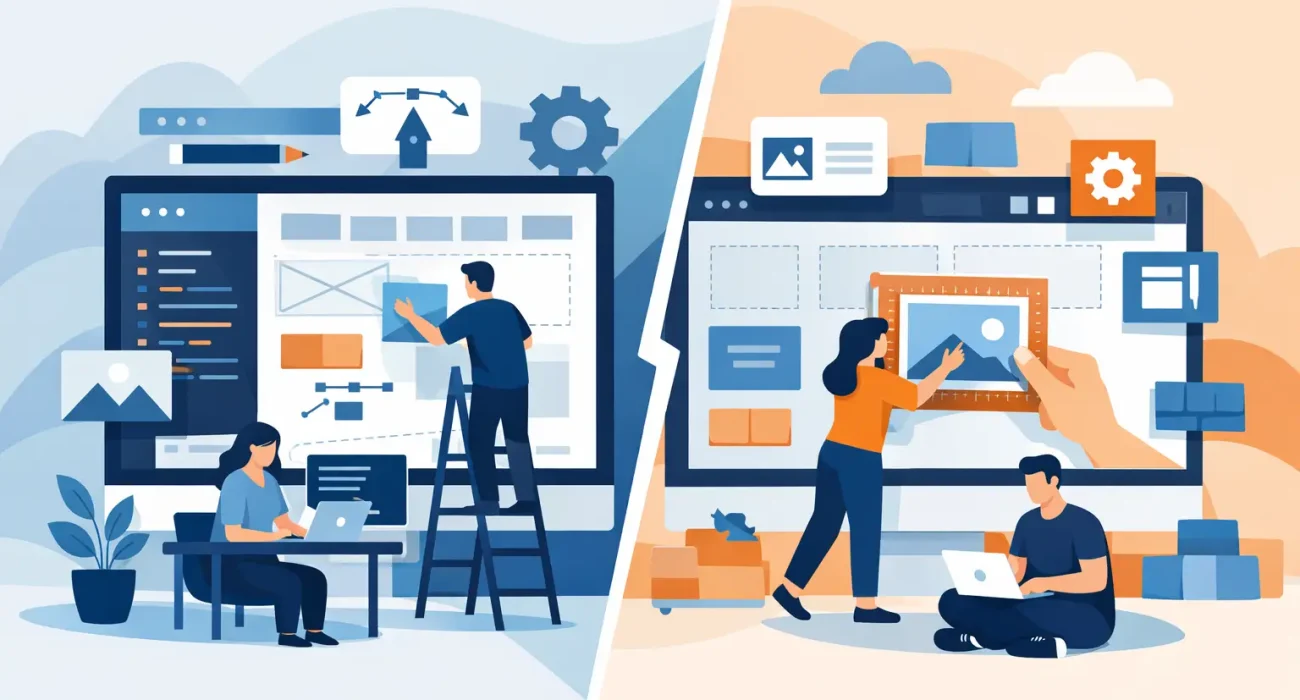
Custom Website vs Website Builder: The Core Difference
A website builder is a pre-built platform that lets users create pages using templates, drag-and-drop blocks, and standard features. It is designed for speed and simplicity. A business can select a layout, add its content, connect a domain, and publish without building every feature from the ground up.
A custom website is planned and developed around specific business requirements. Its layout, functionality, integrations, content structure, and user experience are tailored to how the company operates and how customers need to interact with it. It may still use proven content management technology in the background, but the customer-facing experience and business logic are designed for the organization.
The distinction matters because a website is often part of a larger operating system. It may need to work with a POS system, booking process, property platform, lead pipeline, payment workflow, or marketing campaign. When those requirements are basic, a builder may be enough. When they are central to daily operations or customer acquisition, a custom solution usually creates more value.
When a Website Builder Makes Business Sense
A website builder works well when speed, budget control, and a limited scope are the priority. A new consultancy, small local service provider, or early-stage business may only need a clear introduction, service pages, contact details, and a simple inquiry form. In that situation, a polished template can help the business establish credibility quickly.
Builders are also useful for short-term campaigns, event pages, or businesses testing a concept before making a larger investment. Most include basic mobile layouts, forms, image galleries, blog tools, and simple ecommerce features. For a company with a small product range and no unusual workflow, these tools can cover the essentials.
The trade-off is flexibility. Templates are built to serve many types of businesses, so they cannot anticipate every operational need. A layout may look attractive at launch but become restrictive when the company needs custom pricing rules, advanced lead routing, specialized booking, multilingual content structures, or a closer connection to internal systems.
There is also an ownership question. While you own your content and brand assets, the site remains dependent on the builder’s framework, feature limits, pricing structure, and available integrations. Moving to a different platform later can require rebuilding pages, restructuring content, and replacing functions that were tied to the original provider.
When a Custom Website Is the Better Investment
A custom website is a stronger fit when the website must do more than present information. It is especially valuable when it needs to generate qualified leads, support online transactions, reduce manual work, or represent a differentiated brand in a competitive market.
For example, a restaurant may need menu management, order inquiries, catering forms, branch-specific information, and connections with QR code menu tools. A retailer may require organized categories, promotion rules, product filtering, inventory visibility, and a customer journey that encourages repeat purchases. A property-related business may need property listings, advanced search, agent assignment, inquiry tracking, and forms designed around the information its sales team actually needs.
These are not simply design preferences. They affect response time, staff workload, conversion rates, and the customer’s confidence in the business. A custom build makes it possible to map the website around the real journey: what customers search for, what information helps them decide, and what action should happen next.
Custom development also gives a business more control over performance and search visibility. Search engine optimization is not just adding keywords to a page. It depends on site structure, page speed, mobile experience, content hierarchy, local relevance, and the ability to create targeted landing pages as services expand. A tailored site can be structured from the beginning to support these requirements rather than working around the limits of a template.
Cost Is More Than the Initial Price
A builder typically has a lower upfront cost. That is its most obvious advantage. The business pays a monthly or annual subscription and may purchase additional apps, themes, transaction tools, or premium features as needed. For a straightforward site, this can be a practical and predictable expense.
A custom website requires more planning and a higher initial investment because it includes discovery, design, development, testing, content preparation, and deployment. However, the first price should not be the only decision factor. The relevant question is what the website will cost the business if it cannot support growth, creates manual work, or fails to convert interested visitors.
Consider a business that needs staff to manually transfer website inquiries into a separate system every day. Or a retailer that cannot display the right product information without editing multiple pages. Or a hospitality business that loses bookings because its mobile experience is unclear. Lower initial cost can become more expensive when operational friction continues month after month.
A good custom website should not be overbuilt. Paying for complex features that do not support a business objective is no better than settling for a template that cannot do the job. The right scope is based on current needs, likely growth, and the value of solving specific problems.
Support and Maintenance Should Be Part of the Decision
Both options need ongoing attention. Website builders simplify platform maintenance, but someone still needs to update content, review forms, manage user access, monitor performance, and keep the site aligned with the business. Third-party apps can also introduce compatibility or support issues.
With a custom website, support should be clearly defined from the start. Ask who handles updates, security checks, backups, content changes, technical issues, and future enhancements. A dependable technology partner should explain the scope in plain language and remain available after launch, not disappear once the site goes live.
For businesses operating in Qatar, local understanding can make this support more useful. The website may need to reflect local customer expectations, service areas, bilingual content requirements, delivery workflows, branch operations, and the way customers prefer to make inquiries. Responsive guidance matters when a website is connected to daily sales and operations.
Questions to Ask Before You Choose
Before selecting a platform or approving a development proposal, start with business questions rather than design examples. What action should visitors take? What information do they need before contacting or buying from you? Which internal systems should the website connect with? Who will manage content after launch? What will change if the business adds locations, services, products, or campaigns?
It also helps to identify the cost of a missed opportunity. If one additional qualified lead, reservation, sale, or property inquiry per week would justify a stronger website, that should influence the decision. The goal is not to buy the most advanced technology. It is to build a digital asset that produces measurable commercial value.
A builder is often right for a simple, early-stage presence with limited functionality. A custom website is usually the better route when your online presence must support real workflows, stand out in a crowded market, and scale with the business. SDQ Tek approaches this choice as a business decision first, matching website development to the systems, customer journey, and growth goals that matter most.
Choose the option that removes friction for your customers and your team. A website should make it easier to be found, easier to trust, and easier to do business with you.