

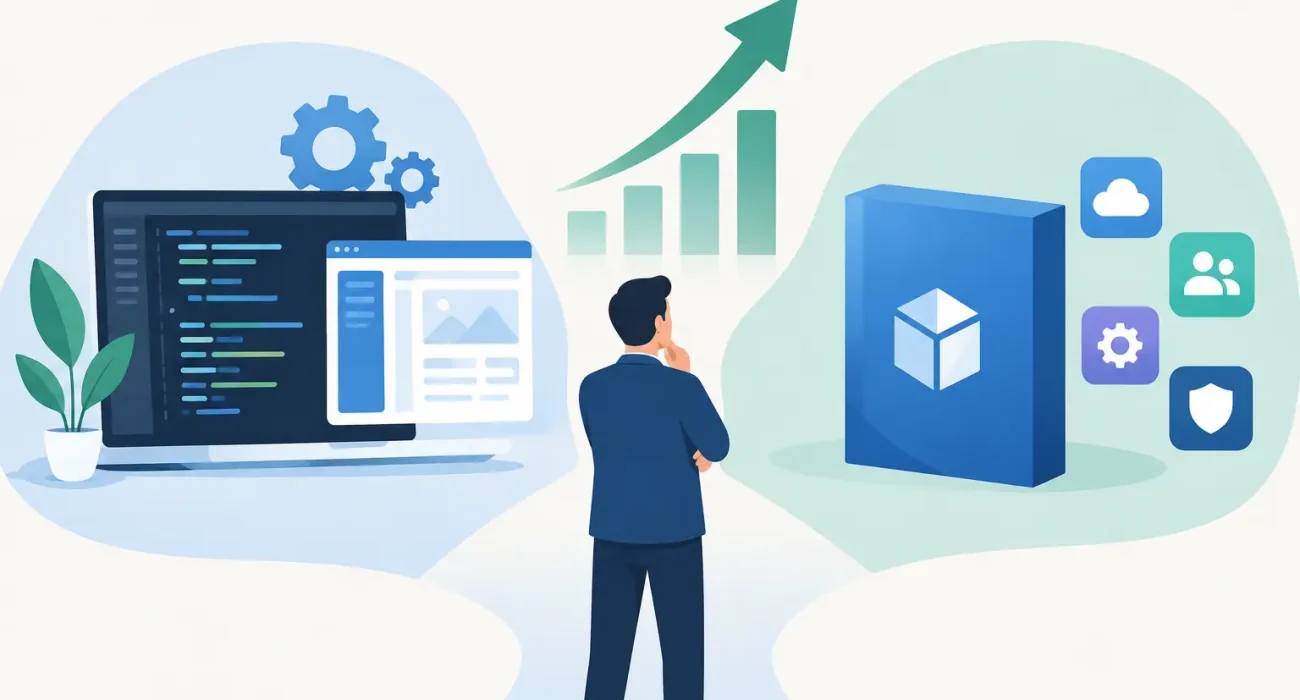
A restaurant manager should not have to maintain one system for orders, another for inventory, a spreadsheet for delivery sales, and a separate process for loyalty offers. Yet this is the reality for many growing businesses. The decision between custom software versus packaged systems often begins when everyday workarounds start costing time, accuracy, and customer confidence.
There is no universal winner. A packaged platform can get a business operating quickly with familiar features and predictable pricing. Custom software can remove bottlenecks that off-the-shelf products were never designed to solve. The right choice depends on how your business operates today, where it is headed, and how much control you need over the technology supporting it.
What Packaged Systems Do Well
Packaged systems are ready-made applications built to serve a broad type of business. Examples include standard restaurant POS platforms, retail inventory tools, accounting software, property management systems, and appointment scheduling applications. The provider defines the core features, updates the platform, and typically charges a monthly or annual subscription.
Their strongest advantage is speed. A retail store opening next month may need barcode scanning, payment processing, stock counts, sales reports, and user access controls without waiting for a development project. A proven packaged system can provide those essentials quickly, often with training resources and a defined setup process.
Cost is another important factor. Upfront investment is usually lower than commissioning a purpose-built platform. This makes packaged software a practical option for startups, single-location businesses, and companies with standard workflows. Subscription pricing also makes budgeting easier, although decision-makers should look beyond the introductory rate and calculate the long-term cost of add-ons, per-user charges, payment fees, integrations, and support plans.
Packaged tools are also valuable when a business benefits from established best practices. A hotel or property operator may not need to reinvent common reservation, tenant, or maintenance workflows. If the platform already supports the way the team needs to work, adopting a proven system can be more sensible than building from scratch.
The limitation appears when the business must change its process to fit the software. Minor adjustments are normal. Major compromises are not. If staff repeatedly export data, re-enter information, rely on unofficial spreadsheets, or skip parts of the system, the platform may be creating friction rather than reducing it.
Where Custom Software Creates Value
Custom software is designed around a company’s actual workflows, data needs, customers, and operating model. It can be a complete business platform, a targeted internal tool, a portal for customers or suppliers, or an integration layer that connects existing systems.
Its value is not simply that it is unique. The value comes from solving a specific operational problem better than a generic application can. For example, a multi-branch restaurant group may need a POS workflow that applies location-specific menus, kitchen rules, central purchasing approvals, delivery channel reporting, and loyalty data in one controlled process. A standard system may cover 70 percent of those needs. The remaining 30 percent can create daily manual work across every branch.
A custom solution can also provide ownership and flexibility. Your business can prioritize the features that matter most, adjust the system as policies change, and avoid paying for modules that add no value. For companies with specialized service models, proprietary processes, or plans to scale across locations, this control can become a competitive advantage.
However, custom development requires clear planning and active involvement. The business needs to define goals, assign decision-makers, test workflows, and prepare staff for adoption. It also needs a reliable technology partner that can provide maintenance after launch. Software is not a one-time purchase. Operating systems, security expectations, devices, payment methods, and business processes all change over time.
Custom Software Versus Packaged Systems: The Real Comparison
The most useful comparison is not feature versus feature. It is operational impact versus total cost over time.
A packaged system usually wins when your processes are standard, you need to launch quickly, and the product already handles the critical parts of your operation. It may be the right decision for a new cafe, a small retailer, or a property business with straightforward requirements. Choosing a platform with good support and room for reasonable growth can prevent unnecessary development spending.
Custom software becomes more compelling when the business has complex workflows, multiple systems that need to exchange data, or recurring manual tasks that consume staff time. It is also worth considering when a limitation in the current system affects revenue, compliance, reporting accuracy, or customer service.
Consider a retailer that spends several hours each week reconciling stock between physical stores, an online catalog, and warehouse records. The problem may not require replacing every tool. A custom integration or inventory dashboard could eliminate duplicate entry while preserving systems the business already knows. Custom development does not always mean building an entire platform from zero.
Decision-makers should assess four areas before selecting a path:
- Workflow fit: Can the software support the way your team actually completes orders, approvals, stock movements, reservations, or service requests?
- Integration needs: Must it exchange reliable data with POS terminals, accounting tools, websites, delivery platforms, payment services, or marketing systems?
- Growth requirements: Will new branches, users, products, reporting needs, or service lines expose limitations within the next two to three years?
- Support and accountability: When an issue interrupts operations, who understands your setup and can respond with a practical solution?
These questions often reveal that the answer is a combination. A business may use a packaged POS system while adding custom reporting, website integration, customer portals, or internal approval workflows. This approach can protect the benefits of proven software without forcing the business into disconnected processes.
Look Beyond the Initial Price
A lower monthly subscription is not automatically the lower-cost option. The cost of a system includes staff time, training, errors, duplicate work, missed reporting opportunities, integrations, upgrades, and downtime. If employees spend hours every week correcting information that should flow automatically, that cost grows quietly.
Custom software has a higher initial investment because it includes discovery, design, development, testing, deployment, and support. The return comes when it reduces labor-intensive steps, improves decisions with better data, or supports a service model that generates more revenue. The business case should be based on measurable outcomes, not the appeal of having software built specifically for your company.
For example, a property management business may justify a custom tenant request portal if it reduces response times, routes issues to the right team, creates an audit trail, and gives management clearer maintenance data. If the portal only duplicates an existing email process without changing the outcome, the investment may not be justified.
Avoid These Common Decision Mistakes
One common mistake is buying the system with the longest feature list. Features that do not support a real business need can make training harder and reporting less clear. Focus on the critical workflows your team performs every day.
Another is customizing a packaged platform beyond its intended limits. Some configuration is useful, but excessive workarounds can make updates difficult and leave the business dependent on fragile solutions. When the gap is fundamental, it is better to evaluate a different platform or build the missing capability properly.
Businesses also underestimate implementation. Even excellent software fails when staff do not understand why the process is changing, data is poorly prepared, or responsibilities are unclear. Allocate time for process review, testing with real scenarios, training, and post-launch support.
Finally, avoid treating local support as an afterthought. For businesses operating in Qatar, practical knowledge of local operations, responsive assistance, and hands-on implementation can matter as much as the software itself. A provider should understand what happens at the counter, in the warehouse, at the front desk, and in the management office, not only what appears on a product demonstration.
Choose Technology That Supports the Business You Want to Run
The best technology decision is rarely about choosing the most advanced product. It is about giving your team a dependable way to serve customers, manage information, and grow without adding unnecessary complexity.
SDQ Tek helps businesses evaluate practical options across business software, POS systems, websites, and digital operations, with implementation shaped around real working requirements. Whether the right answer is a proven packaged platform, a tailored solution, or a carefully planned combination, start with the operational problem. The clearer that problem is, the more confidently you can invest in technology that earns its place in the business.