

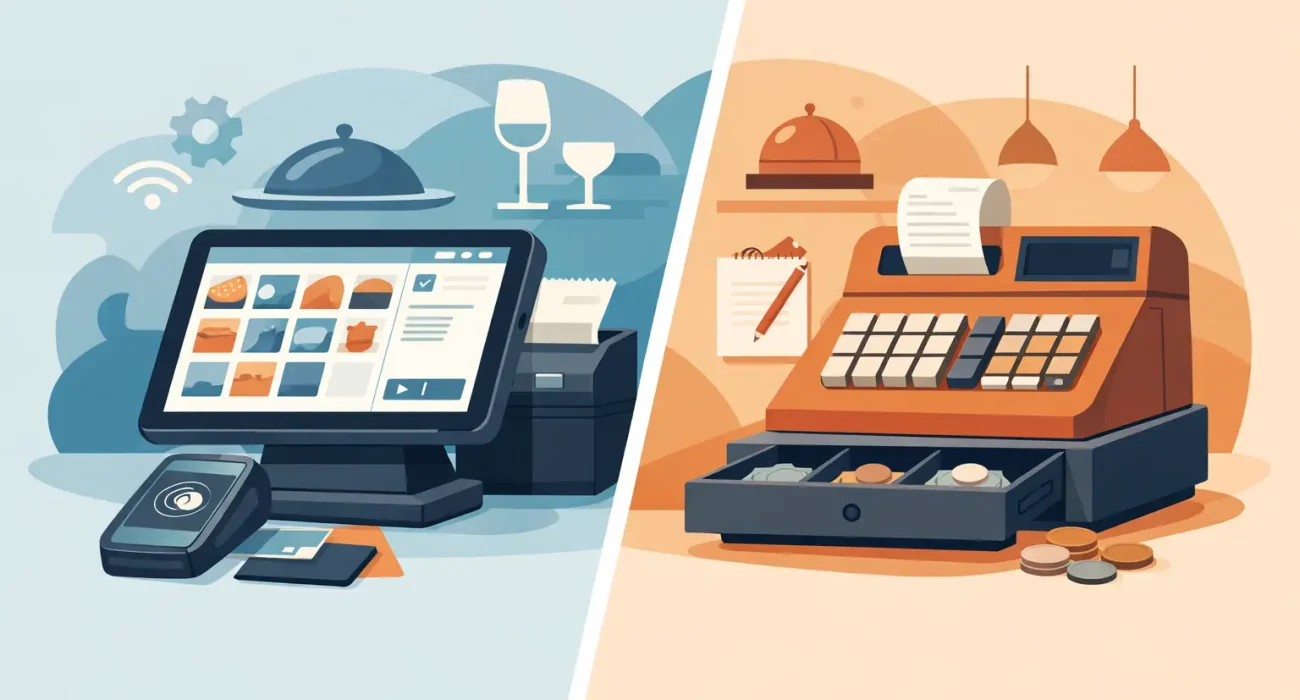
The lunch rush exposes weak systems fast. Orders stack up, staff repeat the same questions, receipts go missing, and managers end up making decisions based on guesswork instead of real numbers. That is why the question of restaurant POS versus traditional cash register matters more than ever for owners who want tighter control over service, costs, and daily operations.
For some restaurants, a cash register still gets the basic job done. It takes payment, opens the drawer, and keeps the line moving. But restaurant operations have changed. Today, many businesses need order accuracy, inventory visibility, staff tracking, delivery coordination, and better reporting from the same system handling the sale.
The right choice depends on your concept, volume, and growth plans. A small kiosk with a limited menu has different needs than a full-service restaurant, a cafe with delivery, or a multi-branch operation. The key is not choosing the newer option just because it sounds better. The real question is which system supports your business without adding unnecessary cost or complexity.
Restaurant POS versus traditional cash register: what is the difference?
A traditional cash register is built for one core function: recording sales and storing cash. Some newer register models may include basic receipt printing, simple tax settings, and limited sales totals, but they remain focused on payment at the counter.
A restaurant POS system does much more. It combines payment processing with order entry, menu management, reporting, user permissions, table tracking, kitchen communication, and often inventory or customer data. Instead of acting as a standalone machine, it becomes part of the restaurant’s wider operating system.
That distinction matters in practice. A register records the transaction after the sale is made. A POS system helps manage the steps before, during, and after the sale. For restaurant owners, that difference often affects speed, accuracy, staffing, and profitability.
Where a traditional cash register still makes sense
Not every business needs a full restaurant POS from day one. If you run a very small operation with a short menu, low daily transaction volume, and limited staffing, a cash register can still be a workable option.
It is usually cheaper upfront and easier to understand. Staff can learn it quickly, and there are fewer features to configure. If your operation mainly accepts simple walk-up orders and you do not need detailed reporting, the register may feel like the more practical choice.
There is also less risk of overbuying. Some businesses invest in systems with functions they never use, then end up paying monthly fees for tools that do not improve operations. In that case, simple can be sensible.
Still, simplicity has a ceiling. Once order flow becomes more complex, the limits show up quickly.
Why many restaurants outgrow the cash register
Restaurants rarely stay static. Menus change, teams grow, delivery channels expand, and owners want a clearer picture of what is selling and where margins are slipping. A cash register does not give much support in those areas.
Take order accuracy. With a basic register, staff often have to memorize modifications, handwrite notes, or verbally pass details to the kitchen. That creates room for mistakes, especially during busy periods. A restaurant POS can send itemized orders directly to the kitchen, including modifiers and special requests.
Then there is visibility. If you want to know your best-selling items, peak hours, voids, discounts, average ticket size, or cashier performance, a POS system can usually provide that data. A register may only give you a broad sales total. That is not enough when you are trying to control food cost, labor, and service quality.
Growth adds another layer. If you plan to open a second location, offer delivery, add QR ordering, or manage promotions more precisely, a traditional register can start holding the business back.
Restaurant POS versus traditional cash register for daily operations
Daily operations are where the investment decision becomes clearer. A cash register handles payment. A restaurant POS supports workflow.
In a dine-in environment, table mapping alone can save time and reduce confusion. Staff can see open tables, active orders, and bill status without chasing handwritten tickets. In quick-service settings, POS systems help speed up order taking with visual menus, combo logic, and modifier prompts.
For kitchen coordination, the gap is even wider. Printed or screen-based kitchen tickets help reduce miscommunication between front-of-house and back-of-house teams. That improves consistency and helps keep service standards in place, especially when new staff are still learning.
Managerial control improves as well. With role-based access, owners can limit who can apply discounts, void items, edit tickets, or close shifts. That level of accountability is difficult to manage with a basic register.
The cost question: upfront savings versus operating value
Cost is often the main reason businesses hesitate. A traditional register usually has a lower upfront price, and that matters for startups watching every expense.
But the better comparison is total operating value, not just purchase price. If a POS system reduces order errors, shortens service time, improves reporting, and helps identify waste or underperforming menu items, it can create measurable returns over time. For many restaurants, that value outweighs the added monthly or implementation cost.
That said, there are trade-offs. A POS system may require setup, training, hardware selection, and ongoing support. If the software is poorly matched to the business, it can feel cumbersome. This is why implementation matters just as much as the software itself.
A dependable technology partner can make the difference between a system that improves operations and one that becomes another problem for staff to work around.
Reporting, inventory, and business decisions
Most restaurant owners do not just want to process sales. They want better decisions from better information.
This is where the traditional cash register falls short. It can tell you what came in at the end of the day, but it usually cannot tell you why performance changed, which items drove revenue, or where money may be leaking through discounts, waste, or inconsistent pricing.
A restaurant POS gives a stronger operational picture. You can review sales by item, category, shift, or employee. You can identify top-performing products, track slow movers, and make pricing or menu decisions with more confidence. If inventory features are included, you can also connect sales activity to stock usage and purchasing patterns.
For owners managing multiple priorities, that visibility is not a luxury. It is part of controlling margins.
Choosing based on your restaurant type
A small coffee stand with five menu items may not need the same setup as a family restaurant with dine-in service, delivery, and rotating specials. That is why the best answer to restaurant POS versus traditional cash register depends on how your business actually operates.
If your process is simple, your team is small, and your reporting needs are minimal, a register may still be enough for now. If your restaurant handles customizations, multiple payment flows, delivery orders, table service, or frequent menu updates, a POS system is usually the stronger long-term fit.
The same applies to growth stage. New businesses sometimes start lean, then upgrade once transaction volume rises. Others choose a scalable POS from the beginning to avoid replacing systems later. Neither approach is automatically right. The better choice is the one that fits current needs while leaving room for sensible expansion.
Implementation matters more than features on paper
Business owners are often shown long feature lists, but day-to-day results depend on how well the system is configured, taught, and supported. A POS with every feature in the market can still underperform if menu setup is poor, staff are not trained properly, or support is slow when problems happen.
That is especially relevant in fast-moving restaurant environments where downtime directly affects revenue and customer experience. Local support, practical onboarding, and responsive troubleshooting matter just as much as software capability.
For businesses in Qatar, this is one reason many operators prefer working with a technology partner that understands local business conditions, service expectations, and implementation realities. SDQ Tek supports restaurants with tailored POS solutions designed around real operational needs, not generic software checklists.
Which one is better?
If your only goal is to ring up sales, a traditional cash register can still do the job. If your goal is to manage service, monitor performance, reduce friction, and make better business decisions, a restaurant POS is usually the better investment.
The real issue is not whether one option is old and the other is modern. It is whether your current system matches the way your restaurant needs to run today. When technology supports staff instead of slowing them down, owners gain something more valuable than convenience – they gain control.
Before you choose, look closely at your daily bottlenecks. The best system is the one that solves those first and still makes sense as your restaurant grows.